Why do particles have mass? And what exactly does this have to do with the Higgs boson discovered in 2012 in the ATLAS experiment and elsewhere? What are the properties thereof? What is dark matter all about? Why exactly are we all made of matter and not antimatter? These are just some of the questions that the 6000 members of the international ATLAS collaboration have dedicated themselves to researching, and which they are investigating using their experiment at the Large Hadron Collider at CERN.
ATLAS is one of two so-called general-purpose detectors at the LHC, giving it a particularly broad research spectrum, which it analyses with the aid of particle collisions. In this process, two protons or ions are collided in its interior and the decay products of the collision are analyzed in the cylindrical detector.
Information About the German Involvement in ATLAS
The Detector
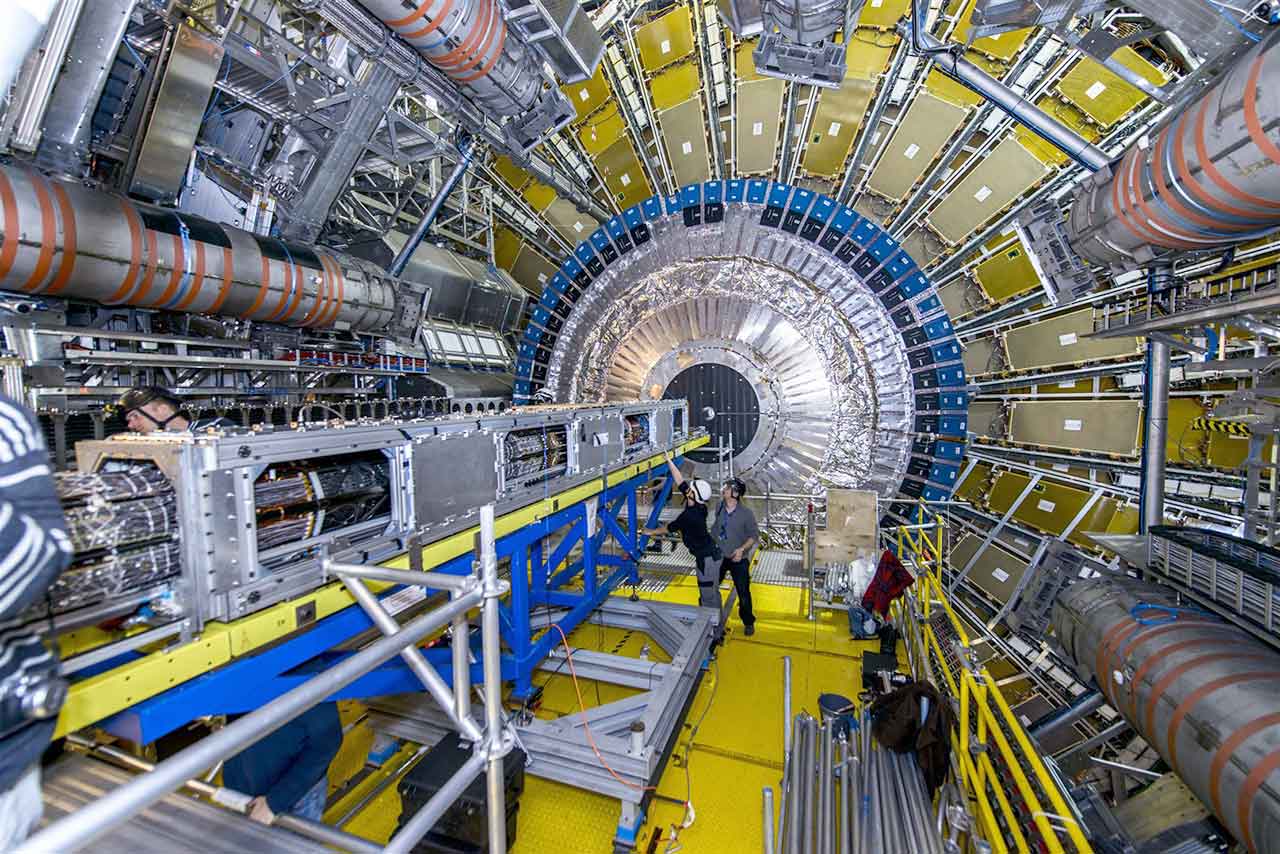
The ATLAS detector weighs an impressive 7000 tons, but what really stands out is its size. Measuring 25 meters in diameter and 46 meters in length, it is the giant among the particle detectors at the LHC. It is made up of various sub-detectors that surround the collision point cylindrically with the aim of achieving a high spatial coverage.
The various sub-detectors each have their own special tasks, such as measuring the particle trajectories, identifying the type of particle, measuring the transverse impulse or the energy of the particles. A sophisticated trigger system then selects the collisions of interest for subsequent analysis in real time based on the recorded data.
The ATLAS detector is divided into four main systems, each of which carries out some of the tasks mentioned above: The inner track detector measures the particle trajectories, the two calorimeters measure the energy of the particles and the muon spectrometer measures the hard-to-measure muons that can reach the outer area of the detector. The systems make use of two different magnets here: One is the superconducting solenoid magnet surrounding the inner track detector, which bends the path of charged particles in the track detector into a helical path. A so-called toroidal magnet is used outside the calorimeter to also bend the paths of the particles in the muon spectrometer - the magnetic field has enormous dimensions of 26 x 20 meters.
Current Research Issues
The ATLAS experiment is a general-purpose detector with a wide-ranging research program that tests the statements of the standard model of particle physics and searches for extensions. One major success of these endeavors for the scientists at ATLAS came with the discovery of the Higgs boson in 2012. Following the discovery, the properties of the Higgs boson now need to be investigated in detail: its mass, its interaction with other particles and the question of whether there may be other Higgs bosons.
Yet many other issues are still unresolved. For instance, research into a completely unknown form of matter in the universe, the so-called dark matter, which promises the ground-breaking discovery of new particles. There is also the question of why we are composed of matter, even though matter and antimatter should have been created in symmetrical quantities in the Big Bang - where did the antimatter go? The methodology involved here is the constant comparison of theoretical models with reality in the detector - for example, checks are carried out to see whether the standard model correctly predicts certain decay processes in terms of their frequency, or whether the measurements indicate new particles or forces. The standard model has so far withstood all of these investigations, repeatedly proving to be astonishingly precise.
The ATLAS Experiment – Profile
Dimensions:
- 46 m length, 25 m diameter
- 7000 tons in weight
Location:
- Meyrin near Geneva, Switzerland
International Collaboration:
- 41 countries
- 181 institutes
- ~ 3000 scientists
German Involvement:
- 16 institutes
- ~ 250 scientists
- ~ 550 completed doctorates
News


Impressions from the ATLAS Collaboration


German Contributions to the ATLAS Experiment
A total of 16 German universities and research institutions with over 250 employees are involved in the ATLAS experiment. These are funded by the Federal Ministry of Research, Technology and Space (BMFTR) through a so-called Research Priority Program (FSP). Universities in Berlin (HU), Bonn, Dortmund, Dresden, Freiburg, Gießen, Göttingen, Heidelberg, Mainz, Munich (LMU and TU), Siegen, Wuppertal, Würzburg as well as DESY in Hamburg and the MPI for Physics in Munich are involved in the ATLAS FSP.
The German groups make significant contributions in various fields within the international ATLAS collaboration. When it comes to the construction and further development of the detector, German groups play a significant role in all ATLAS detector systems. From the pixel detector to the liquid argon calorimeters through to the end-cap myon detectors, the German institutes are heavily engaged in research and development as well as construction. Several research groups are also involved in the further development of the various trigger systems used to select relevant particle collisions.
The scientists at the German institutes are playing an equally important role in analyzing the data obtained with ATLAS - for example in the precise measurement of the Higgs boson. This also includes the search for dark matter, the search for exotic particles and new phenomena or the precise investigation of the top quark, the heaviest of all known elementary particles.

The Upgrade
The ATLAS detector has been able to record enormous amounts of data during the LHC's operation to date and achieved great success with the Higgs discovery. Operation of the LHC was resumed in 2022 following a long shutdown (LS2) with a center-of-mass energy of 13.6 TeV, which had never been reached before. The ATLAS detector was continuously further developed during this time and the "New Small Wheel" was added as a further muon detector. A new Level 1 trigger was also installed to improve the performance of the detector.
Further Development of the ATLAS Detector
The further development of the LHC will see it upgraded to the so-called High-Luminosity LHC (HL-LHC) at the end of this decade. This will increase the beam intensity by a factor of almost ten. This also presents new challenges for the ATLAS detector, since the demands on the detector and the materials will be many times higher in HL operation. As a result, a comprehensive upgrade is needed, including replacing almost all ATLAS detector components, which will be undertaken in the next long shutdown (LS3). This will prepare the detector for the higher radiation intensities and collision rates. The systems apart from the actual detector - such as the trigger systems, which must be capable of handling the flood of data, or the analysis systems in the various institutes - will also be enhanced. The German ATLAS groups are involved with all of these upgrades and even construct some of the components on site in their laboratories prior to their assembly at CERN.

Speaker of the ATLAS Research Priority Program
"The ATLAS detector is an instrument that is incredibly versatile. The data recorded is used for research in almost all areas of elementary particle physics: from measuring the properties of the Higgs boson discovered in 2012, precision measurements of quantum chromodynamics, detailed investigations of the top quark through to searches for supersymmetric and exotic particles and measurements in collisions of heavy ions. The level of creativity with which new reconstruction and analysis methods are devised and implemented is impressive. Such progress enables measurements that were not believed possible for a long time in proton-proton collisions. This opens doors to unknown areas of elementary particle physics."
Prof. Dr. Wolfgang Wagner
Professor of experimental particle physics
University of Wuppertal
Institutions Involved and Associated Members